What is Loan Against Mutual Fund? Complete Guide
6 July 2026 5 min read

What is a Loan Against Mutual Funds? Complete Guide for Indian Investors
If you hold mutual funds in India, you are sitting on a financial tool that most investors never use. A loan against mutual funds lets you borrow money by pledging your existing mutual fund units as collateral. You get cash. Your units stay invested. Your SIPs keep running. Then, everything goes back to exactly how it was as soon as you repay.
| India had over 5.4 crore unique mutual fund investors in 2025 - yet most don’t know they can borrow against their portfolio without redeeming a single unit. |
This guide breaks it down from scratch.
What is Loan Against Mutual Fund -Key Takeaways
- A mutual fund loan is a secured overdraft facility where your MF units serve as collateral
- You can borrow up to 50-75% of NAV for equity funds and up to 80-90% for debt funds, depending on the lender
- Interest rates range from 9-13% p.a.*, significantly lower than personal loans at 14-24%
- Your investments continue compounding during the loan tenure
- No capital gains tax is triggered since no units are sold
What is a Loan Against Mutual Funds?
You pledge your mutual fund units to a lender. The lender marks a lien on those units through CAMS or KFintech, India’s two registrar and transfer agents. A lien means those specific units are locked. You can’t sell them or switch them to another scheme until the loan is repaid.
In return, you get an overdraft facility. This is where the loan on mutual funds works differently from a regular term loan. You receive a credit limit, and you withdraw only what you need. Interest is charged only on the withdrawn amount, not the full sanctioned limit. You can repay in chunks at any time and redraw again if needed.
Your SIPs continue. Dividends on pledged units still come to you. The rest of your portfolio stays completely free.
Who Can Apply for Loan Against Mutual Funds?
The eligibility criteria are straightforward:
- Indian resident (some lenders accept NRIs with Indian MF holdings)
- Age: 18 to 70 years
- Minimum mutual fund portfolio: typically, ₹50,000
- Active PAN and Aadhaar linked to the bank account
- Funds registered with CAMS or KFintech
Both salaried and self-employed individuals qualify. Unlike personal loans, your income, employer profile, or CIBIL score play a minimal role because this is a secured facility. The collateral does the talking.
How Much Loan Can You Get? Understanding LTV Ratios
The loan amount is in accordance with the Loan-to-Value (LTV) ratio, which varies by fund type. After the RBI’s February 2026 amendment, the regulatory ceiling for equity mutual fund units was raised to 75%. However, most lenders still apply conservative internal limits.
Here’s what that looks like in practice:
| Fund Type | RBI LTV Cap (2026) | Typical Lender LTV | ₹10L Portfolio Gets You |
| Equity MF | 75% | 45-50% | ₹4.5-5 lakh |
| Debt MF | No fixed cap | 75-90% | ₹7.5-9 lakh |
| Hybrid MF | ~60-65% | ~55-60% | ₹5.5-6 lakh |
One important update: as of the RBI’s February 2026 direction, loans to individuals against eligible securities are capped at ₹1 crore per individual across the banking system, effective July 1, 2026.
The LTV is recalculated daily based on the current NAV of your pledged funds. If markets drop, your available credit limit drops with it.
A Practical Example: How the Numbers Work
Say you have ₹12 lakh in a large-cap equity mutual fund. The lender offers a 50% LTV, giving you a credit limit of ₹6 lakh.
You need ₹3 lakh for a medical emergency. You withdraw ₹3 lakh and use it for 4 months at 9.3% p.a.*
- Interest cost: ₹3,00,000 × 9.3% × (4/12) = ₹9,300
- If you had redeemed ₹3 lakh instead: You’d pay LTCG tax at 12.5% on proportional gains above ₹1.25 lakh [Section 112A, Income Tax Act], lose the compounding on those units permanently, and potentially face a 1% exit load
Your remaining ₹12 lakh portfolio (including the pledged units) continues compounding at, say, 12% annual returns. That ₹12 lakh earns roughly ₹48,000 in the same four months. You paid ₹9,300 in interest, and your portfolio earned ₹48,000. The math is clear.
Pros and Cons of a Loan Against Mutual Funds
Pros:
- Interest rates of 9-13% p.a*., lower than personal loans or credit cards
- Funds within 24 hours on digital platforms
- No capital gains tax since units are pledged, not sold
- SIPs and compounding continue uninterrupted
- Minimal documentation: PAN, Aadhaar, and your MF folio
- Zero foreclosure charges on platforms like Liquify
Cons:
- Market drops can trigger margin calls, requiring extra collateral or partial repayment
- Pledged units are locked and cannot be switched or redeemed until repayment
- Interest accumulates on withdrawn amounts, so delayed repayment increases the cost
- Not suitable for long-term borrowing needs beyond 6-12 months
- ELSS, close-ended, and some sectoral funds are not eligible
Know Your Options Before You Need Them
The worst time to figure out how to access cash is during a crisis. If you hold mutual funds, check your eligibility for a loan against mutual funds today. Know your credit limit. Know which schemes qualify. That five-minute check now could save you from a panic redemption later.
Need cash without liquidating your investments?
Get a credit line from ₹25,000 at 9.75% p.a. Your mutual funds remain 100% invested.
More Insights from Liquify
View all
How Mutual Fund Redemption Impacts Long-Term Wealth Creation
How Mutual Fund Redemption Impacts Long-Term Wealth Creation Every month, a large number of Indian investors make a mutual fund re...
Loan Against Mutual Funds Tax 2026
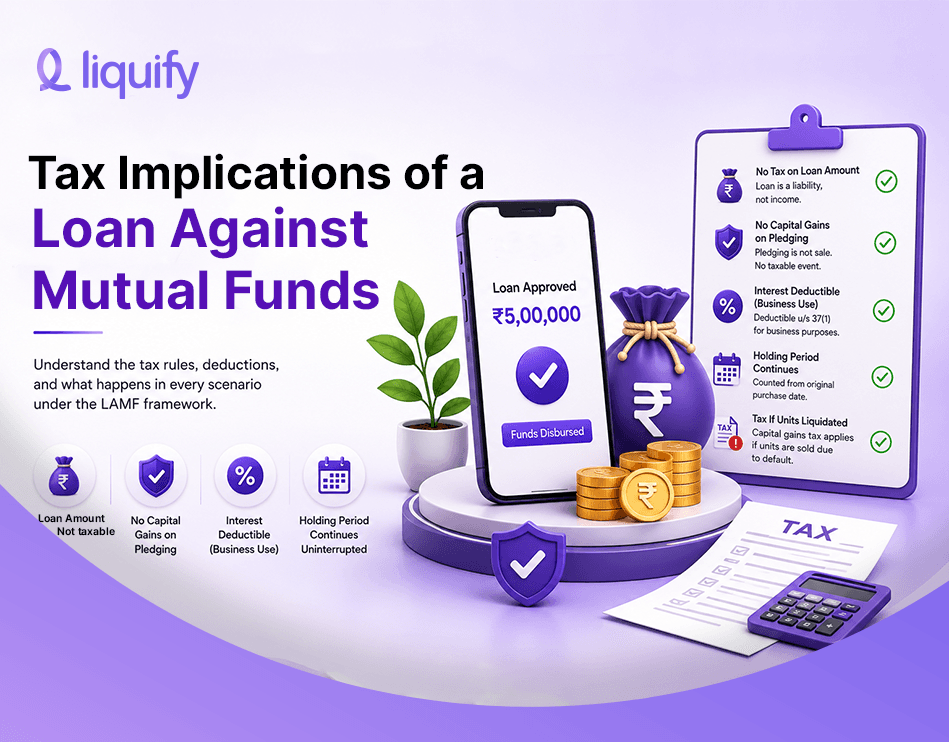
Tax Implications of a Loan Against Mutual Funds The biggest tax advantage of a loan against mutual funds tax 2026 framework is si...
Emergency Fund vs Mutual Fund Loan
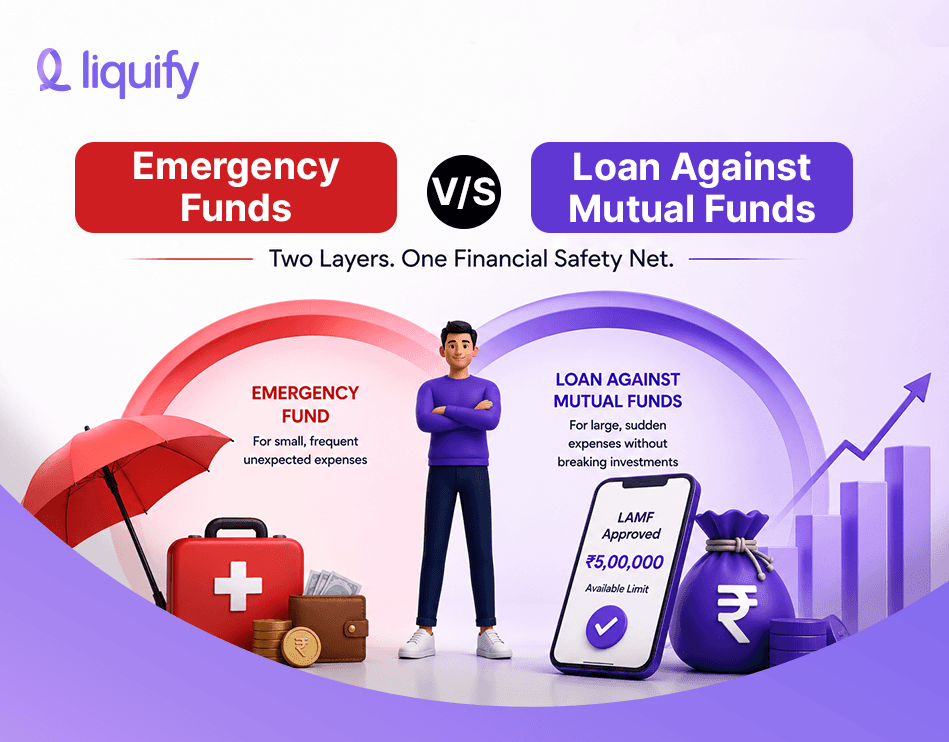
Emergency Fund vs Loan Against Mutual Funds Most financial advice treats emergency fund vs mutual fund loan as separate topics. Th...